From Token Cost to Enterprise Value: The Wrong Approach
The costs of AI are falling. Meanwhile, its uses are skyrocketing. As AI agents become integrated into business processes, consumption volumes are rising much faster than prices are falling. In this context, simply counting tokens is no longer enough. The real question isn’t how much AI costs, but what value it generates. For executives, the challenge is no longer to control technology spending, but to measure the return on every euro invested. It is this new economic equation that organizations must now learn to manage.
Unit costs are plummeting, while the total bill is rising
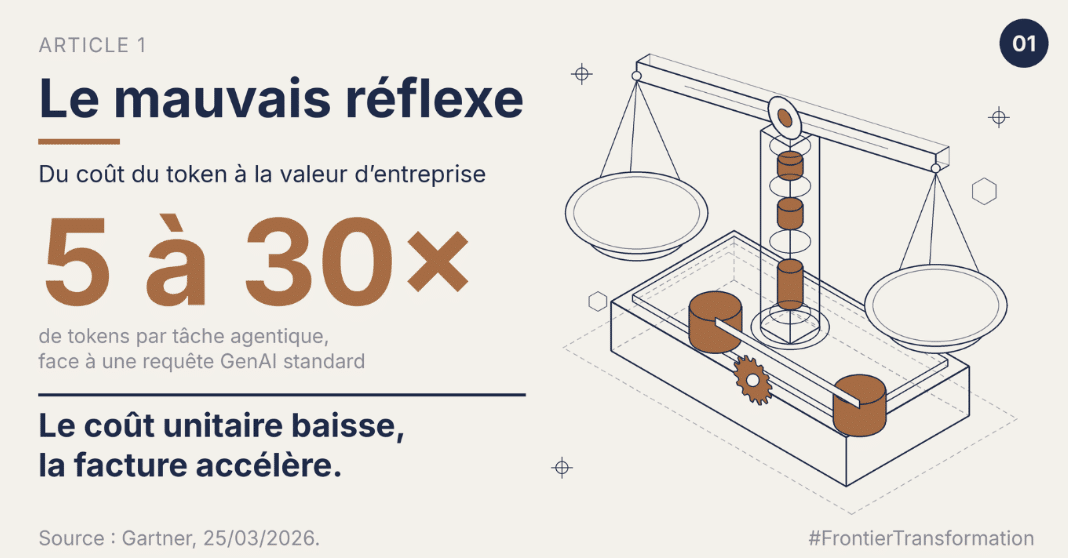
The price of an inference token is plummeting, and serious projections anticipate a drop of more than 90 percent in unit cost by 2030. This prospect naturally instills a sense of reassurance among executive committees—the idea that the issue will resolve itself if they simply wait. Organizations that already have agents in production are seeing the opposite. An agent does not consume resources like a chatbot because it reasons, follows a sequence of steps, utilizes tools, and iterates until it reaches a result—which requires five to thirty times more tokens than a standard GenAI query for the same task. The unit cost decreases as volume skyrockets, and the gap widens precisely as scale increases. The bill won’t wait until 2030 to rise—it’s already rising now in the most advanced organizations.
The first instinct is to count, and that’s already the first mistake
I see this in every organization that crosses the threshold into industrialization. Consumption becomes visible, a number pops up, and it’s shocking—billions of tokens or a six-figure bill that no one had anticipated. The reaction then follows a predictable sequence: count, cap, and then reduce. Some organizations make the opposite mistake—driven by the same underlying logic—when they reward raw consumption as proof of adoption. In both cases, they’re focusing on a counter that says nothing about what was produced, nothing about the value created, and nothing about the profit generated. Counting tokens is like judging an investment by its amount while ignoring its return, even though the only question that matters is almost never asked: How much value is generated for every euro spent?
Volume screams, cost whispers, value flips
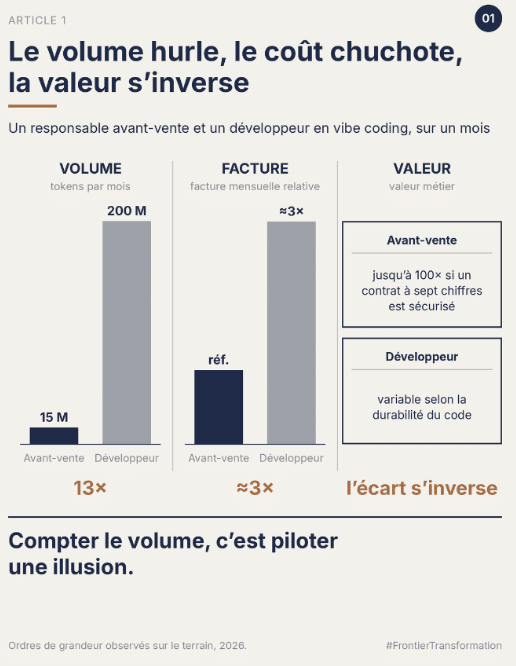
A stark contrast makes the point clear, based on orders of magnitude observed in the field. A pre-sales manager preparing sales proposals uses at least fifteen million tokens per month, while a developer in an intensive coding session uses more than two hundred million—sometimes five hundred million or more—which is thirteen times as much at the low end of the range. A manager who looks only at volume immediately concludes that the developer costs thirteen times more, whereas the bulk of the developer’s tokens come from context review—billed at a fraction of the price of a produced token—while those of the pre-sales representative are generated text, which is more expensive per unit. The actual cost difference is about three, so the counter was off by a factor of four. The third step turns everything on its head, because the presale—which consumes thirteen times less—can generate a hundred times more value if its proposal secures a seven-figure contract. Three different ways of interpreting the data yield three different rankings, and focusing on volume amounts to rewarding exactly the wrong behavior.FinOps Becomes FinOps AI, and the Token Enters the P&L
I wrote this past spring, in my series on agent-based platforms, that the agent-based economy is based on a cost model that didn’t exist three years ago and that, without a shared economic understanding, the topic remains indefensible before a budget committee. This three-part series expands on that pillar. The discipline that previously managed cloud costs has, in fact, shifted its focus this year, as it no longer manages the value of the cloud but rather the value of the technology—AI spending having gone from being an exception to a standard component of the budget in just two years. The token has become an economic unit on par with a license or an hour of computing time. The guidance I provide to management is clear. The CIO ensures transparency, with expenses broken down by team and use case. The CFO enforces the language of metrics—the value generated for every euro spent rather than the volume consumed. The CEO evaluates use cases based on their proven return on investment, not their visibility. Software vendors themselves are moving in this direction and shifting their billing models from a token-based approach to a results-based one. Managing by cost per result today means speaking the language of your future contracts. The question is no longer how many tokens your organization consumes, but rather who in your organization can link each token spent to the value created. Those who measure volume are chasing an illusion. Those who measure results are building a competitive advantage.
Once the impulse to count is set aside, the real question remains: the discipline of linking each token to a result. That is the subject of the next article.
Le FinOps devient FinOps IA et le token entre dans le P&L
J’écrivais au printemps, dans ma série sur les plateformes agentiques, que l’économie agentique repose sur un modèle de coûts qui n’existait pas il y a trois ans et que sans lecture économique partagée le sujet reste indéfendable en comité budgétaire. Ce triptyque développe ce pilier. La discipline qui pilotait hier le coût du cloud a d’ailleurs changé d’objet cette année puisqu’elle ne gère plus la valeur du cloud mais la valeur de la technologie, la dépense IA étant passée en deux ans du statut d’exception à celui de périmètre standard. Le token est devenu une unité économique au même titre qu’une licence ou une heure de calcul. La guidance que je donne aux directions est claire. Le CIO construit la lisibilité, une dépense attribuable par équipe et par cas d’usage. Le CFO impose le langage du ratio, la valeur produite pour chaque euro dépensé plutôt que le volume consommé. Le CEO arbitre les usages sur leur rendement démontré et non sur leur visibilité. Les éditeurs eux-mêmes prennent cette direction et font glisser leurs modèles de facturation du token vers le résultat. Piloter au coût par résultat aujourd’hui, c’est parler la langue de vos contrats de demain. La question n’est plus de savoir combien de tokens consomme votre organisation mais de savoir qui, chez vous, sait relier chaque token dépensé à une valeur créée. Ceux qui mesurent le volume pilotent une illusion. Ceux qui mesurent le résultat construisent un avantage.
Le réflexe de compter une fois écarté, reste la vraie question, celle de la discipline qui relie chaque token à un résultat. C’est le sujet du prochain article.
Written by
-

Charles Collier
Leader AI Tech Strategy & Cloud Architecture