Agentic AI Radar
Your tool for understanding, comparing, and tracking the evolution of the agentic AI market.

Why now?
New agentic solutions emerge every week. They all promise to transform operations, but few demonstrate true maturity, strong governance, and the ability to scale. The Agentic AI Radar helps you separate signal from noise, identify credible solutions, and track the evolution of a rapidly accelerating ecosystem.
The agentic AI market is moving fast. Your decisions need to be sound.
A new era to navigate
After years of experimentation, POCs, and forward-looking discussions, AI agents are entering a more concrete phase: industrialization. Organizations now need to assess what can genuinely create value, under what conditions, and with what risks.
Trend or lasting advantage?
In a market saturated with announcements, the ability to distinguish a structural innovation from a passing trend is becoming a competitive advantage. Decision-makers need a clear framework to prioritize, invest, and move forward with confidence.
Truly agentic?
The term “agentic” is now being used by a growing number of solutions. Yet few combine sufficient autonomy, robustness, integration, traceability, and governance mechanisms to support critical production use cases.
A radar to understand, compare, and decide
The Agentic AI Radar serves as a strategic decision-making tool. It helps align technology choices with organizational maturity, governance requirements, sovereignty considerations, and business objectives. In practical terms, it provides a more nuanced view of the market, with less noise and more decision-making criteria.
- Maturity and momentum: two dimensions for assessing both the strength of a solution and the pace of its adoption.
- Past trajectories and future projections: understand how each solution is evolving, how it is positioned, and how it could gain or lose relevance over time.
- Individual analysis: identify the strengths, limitations, and conditions of use for each agentic system.
- Sovereignty: incorporate considerations related to digital resilience, data control, and technological independence.
- Vendor dependency: assess the risks of technology lock-in and anticipate their impact on future agility.
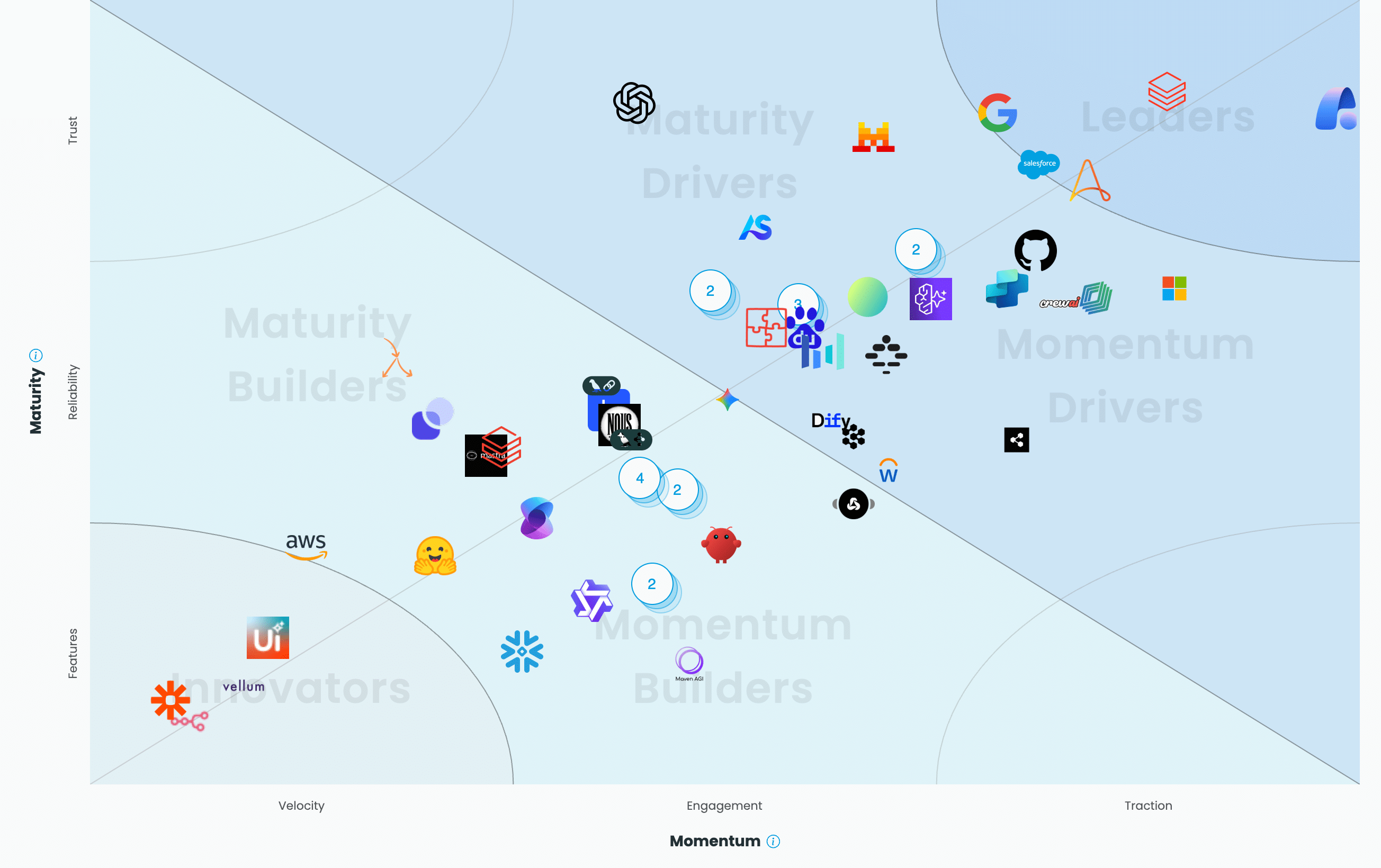
The Agentic AI Radar is a practical advisory tool that helps our clients understand the market, prioritize the right use cases, and make informed decisions.
Move from monitoring to decision-making
The Agentic AI Radar turns market signals into concrete paths to action: selecting the right solutions, structuring the right use cases, reducing risk, and accelerating transformation with sound judgment.
Assess the tension between maturity and momentum
A solution with strong momentum but limited maturity may disappoint when faced with real-world production environments. Conversely, a mature solution that is losing momentum may create a risk of obsolescence or technical debt. Looking at both dimensions together helps avoid blind spots.
Move beyond the "best tool" mindset
The Radar is not designed to establish a universal ranking. Instead, it helps organizations make trade-offs based on context: the right choice depends on the use case, the level of governance in place, the existing technology environment, and the organization’s ability to absorb change.
Take an independent and responsible approach
The Radar takes a deliberately independent approach. Its purpose is not to promote a technology or vendor, but to give decision-makers a robust framework for navigating a market where the pace of change often exceeds traditional decision-making cycles. Without a clear framework, market monitoring remains fragmented and decision-making becomes reactive.
Move from observation to action
We help organizations turn signals from the agentic AI market into strategy, products, and real transformation.